



Design Thinking for Innovative Software Solutions
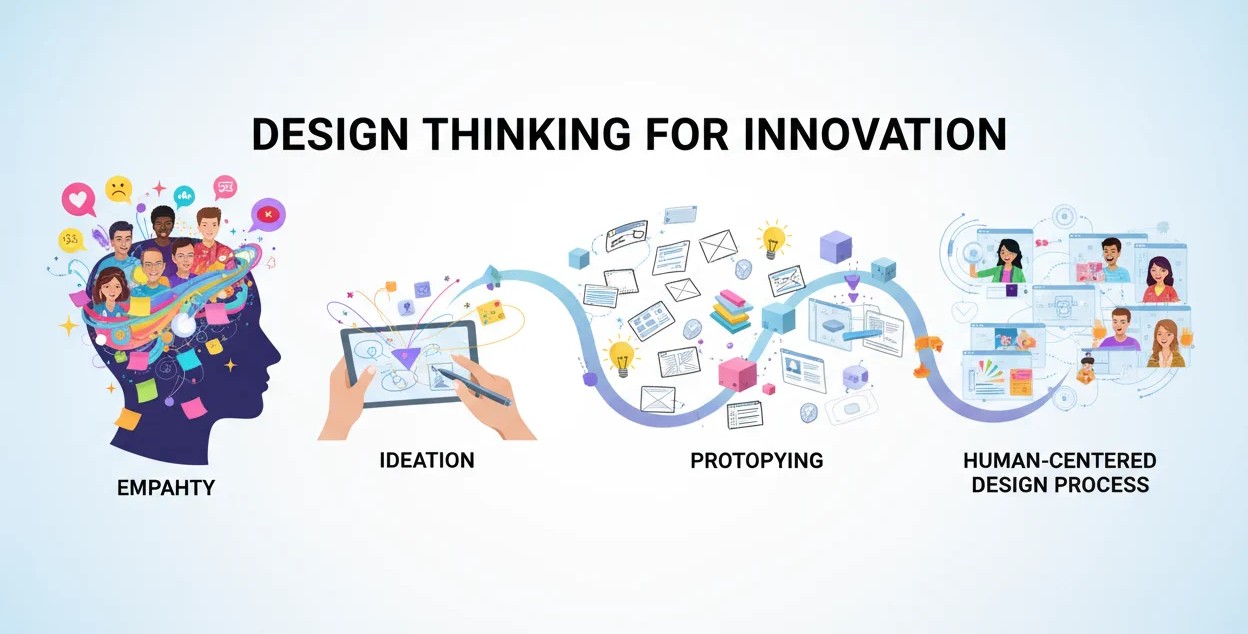
Design thinking has emerged as a powerful framework for innovation in software development, shifting focus from technology-first to human-first approaches. This methodology emphasizes deep understanding of user needs, creative problem-solving, and iterative experimentation to create software solutions that genuinely improve people's lives rather than simply showcasing technical capabilities.
Unlike traditional waterfall development where requirements are locked down early, or even conventional agile approaches that may focus primarily on delivery velocity, design thinking centers the entire process around user empathy and continuous learning. The result is software that's not just functional but delightful, not just usable but truly valuable to the people who use it.
The Five Stages of Design Thinking
Design thinking follows a five-stage iterative process: Empathize, Define, Ideate, Prototype, and Test. These stages aren't strictly linear—teams often cycle back to earlier stages as they learn more. This flexibility allows for continuous refinement based on real insights rather than assumptions.
Each stage serves a specific purpose in moving from problem identification to validated solution. Empathize involves deep user research to understand genuine needs and pain points. Define synthesizes research into clear problem statements. Ideate generates diverse potential solutions. Prototype creates quick, testable representations of ideas. Test validates concepts with real users to inform the next iteration.
Empathize: Understanding User Needs
Empathy is the foundation of design thinking. This stage requires setting aside assumptions about what users want and instead observing, engaging, and immersing yourself in their experiences. Conduct user interviews, observe people using existing solutions, and gather qualitative data about their challenges, motivations, and contexts.
Effective empathy research goes beyond asking users what features they want. People often can't articulate their needs clearly, or they request solutions rather than describing problems. Good researchers observe behavior, note contradictions between stated preferences and actual actions, and probe deeper into the 'why' behind surface-level complaints or requests.
Define: Framing the Right Problem
The Define stage synthesizes empathy research into actionable problem statements. A well-crafted problem definition focuses on user needs rather than jumping to solutions. For example, instead of 'We need a mobile app,' a better problem statement might be 'Busy professionals need a way to manage their tasks while commuting because they feel overwhelmed when reaching the office.'
This reframing is crucial because the problem you choose to solve determines the solutions you'll explore. Many software projects fail not because of poor execution but because they solve the wrong problem beautifully. Taking time to define the right problem prevents wasted effort and increases the likelihood of creating meaningful impact.
If I had an hour to solve a problem, I'd spend 55 minutes thinking about the problem and 5 minutes thinking about solutions.
Albert Einstein
Ideate: Generating Creative Solutions
With a clear problem definition, the Ideate stage focuses on generating a wide range of potential solutions. Brainstorming sessions, sketching exercises, and collaborative workshops help teams think divergently before converging on the most promising ideas. The goal is quantity over quality initially—wild ideas often contain seeds of breakthrough innovation.
Effective ideation requires creating psychological safety where team members feel comfortable suggesting unconventional ideas without judgment. Defer criticism during brainstorming, build on others' ideas, and encourage wild thinking. The evaluation comes later; during ideation, the goal is expanding the solution space as widely as possible.
Prototype: Making Ideas Tangible
Prototyping transforms abstract ideas into tangible artifacts that can be tested with users. The key principle is building the simplest possible version that allows you to learn what you need to learn. Early-stage prototypes might be paper sketches, clickable mockups, or basic functional prototypes—whatever enables testing core assumptions with minimal time investment.
Resist the temptation to over-invest in early prototypes. The goal isn't creating a polished product but learning quickly and cheaply. Paper prototypes can validate interaction flows, clickable designs can test user comprehension, and minimum viable products (MVPs) can gauge actual usage patterns. Each level of fidelity serves different learning objectives.


Test: Learning from User Feedback
Testing brings prototypes to users to gather feedback, observe behavior, and validate or invalidate assumptions. The goal isn't confirming that your solution works—it's learning whether it solves the real problem in a way users find valuable. Be prepared for surprises; users often interact with prototypes in unexpected ways that reveal new insights.
Good testing combines observation with inquiry. Watch what users do, not just what they say. Note where they struggle, what they skip, and what delights them. Follow up with questions to understand the reasoning behind their actions. This combination of behavioral data and qualitative feedback provides rich insights for the next iteration.
Integrating Design Thinking with Agile Development
Design thinking and agile development complement each other beautifully. Design thinking's exploratory front-end work—empathy, definition, and ideation—helps ensure you're building the right thing. Agile's iterative development approach then helps you build it right. Many teams run design sprints ahead of development sprints, validating concepts before investing in production-quality code.
This integration prevents a common pitfall: agile teams efficiently building features that users don't actually need. By front-loading user research and validation, you ensure development velocity is directed toward genuinely valuable outcomes rather than just completing story points.
Common Challenges and How to Overcome Them
- Time pressure: Start with mini design sprints focusing on the riskiest assumptions
- Stakeholder buy-in: Share user research videos and prototype test results to build empathy
- Remote collaboration: Use digital whiteboarding and async feedback tools effectively
- Balancing user needs with business goals: Frame business objectives as constraints, not contradictions
- Analysis paralysis: Set time boxes for each stage to maintain momentum
- Lack of user access: Start with internal users, support teams, or alternative research methods
Measuring Design Thinking Success
Success metrics for design thinking differ from traditional software metrics. Beyond on-time delivery and budget adherence, measure user satisfaction scores, feature adoption rates, reduced support tickets, and achievement of intended user outcomes. Track how often assumptions are validated versus invalidated—high invalidation rates early on are actually positive, indicating you're learning before expensive mistakes.
Long-term success shows in reduced rework, higher user retention, positive word-of-mouth, and competitive differentiation. Products built with genuine user insight tend to require fewer pivots and command stronger market positions because they solve real problems effectively.
DevsMotion's Human-Centered Approach
At DevsMotion, design thinking isn't a separate phase—it's woven throughout our entire development process. We begin every project with user research to understand real needs, not just stated requirements. Our designers and developers work collaboratively, testing assumptions early and often through rapid prototyping and user feedback sessions.
We've seen repeatedly how this approach leads to better outcomes: software that users actually love to use, products that gain traction faster, and solutions that stand out in crowded markets. By starting with empathy and maintaining user focus throughout development, we help clients create software that delivers genuine value and competitive advantage.